
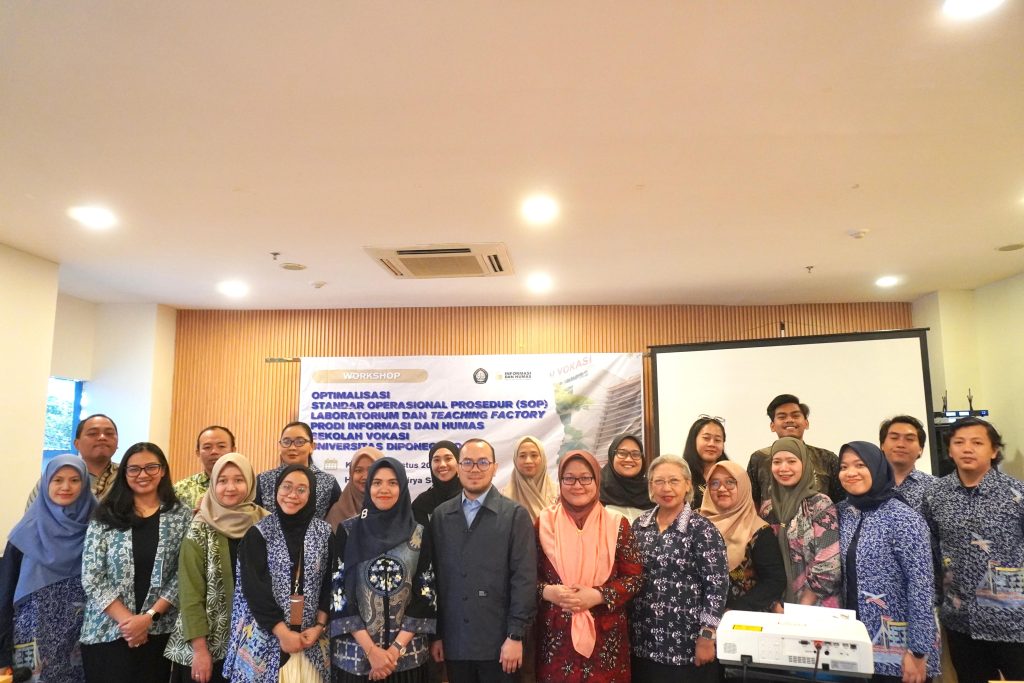
The Study Program of Information and Public Relations, Vocational School, Diponegoro University (UNDIP) held an internal quality improvement activity titled “Workshop on Optimizing Standard Operating Procedures (SOPs) for Laboratories and Teaching Factories (Tefa)” on 6 August 2026. The workshop, aimed at the program’s lecturers and laboratory coordinators, was designed to strengthen governance of academic support facilities, support preparations for LAMSPAK accreditation at the Excellent level, and ensure safe and comfortable laboratory environments for the university’s academic community.
The event opened with remarks from the Head of the Study Program, Arifa Rachma Febriyani, S.I.Kom., M.I.Kom. In her address, Arifa explained that the workshop is a strategic step toward meeting the requirements for LAMSPAK’s Excellent accreditation and part of the Study Program’s broader preparation to become a leading program by ensuring laboratories are safe and comfortable for use. She added, “We hope this strategic activity will help the laboratory and Tefa coordinators and their teams to collaborate more synergistically with existing labs and Tefas as well as those still under development.” She emphasized that the workshop is expected to foster an integrated, productive academic ecosystem ready to support vocational education quality at the national level.
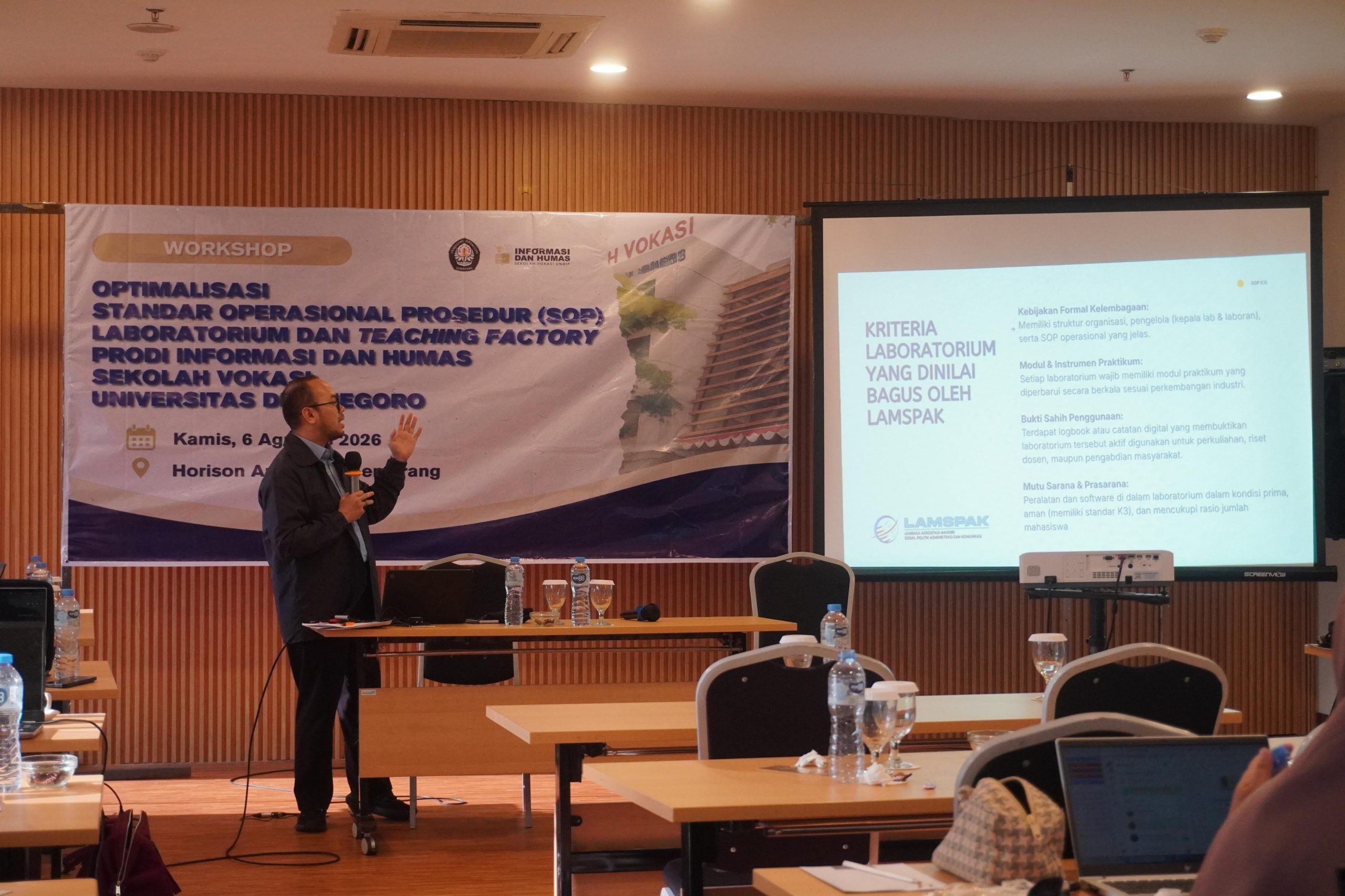
Following the opening, the main presentation on optimizing SOPs for laboratories and Teaching Factories was delivered by Abdul Kholik, S.Sos., M.I.Kom., MCE. Abdul Kholik is a lecturer in Public Relations and Digital Communications at the State University of Jakarta, an online tutor for the Department of Communication Studies at Universitas Terbuka, and a web designer at PT. Global ZERONE Digital. His presentation covered the urgency of sound laboratory governance, stressing that activities outside formal teaching should be coordinated directly with the laboratory. He highlighted the importance of compiling portfolios of practical work and research results and consistently documenting all laboratory activities. He also noted that establishing a laboratory requires a formal Decree (SK) and a clear legal basis for its formation, along with strict oversight of governance. Quoting his message, “Understanding regulations is the key to realizing good laboratory governance,” he reminded participants that portfolios, SOPs, and innovation are primary indicators in quality assessment. He also noted that the use of artificial intelligence (AI) is permissible as long as it follows realistic workflows, with AI-generated drafts serving as initial material to be refined by lecturers.
After the presentation, the workshop continued with an interactive practical session on drafting SOPs for laboratories and Tefas. During this session, the presenter also addressed the importance of integrating Occupational Safety and Health (K3) into laboratory and Tefa SOPs. Emphasizing this point, Abdul Kholik stated, “SOPs are the foundation and K3 is the complement. Without SOPs, everything is ad hoc; and without K3, everything is chaotic,” underscoring that SOPs and K3 form an integral unity for achieving professional, safe, and high-quality laboratory operations.
Laboratory managers and lecturers responded positively to the program. Participants reported that the materials and practical exercises provided new, applicable insights—particularly in drafting governance instruments, understanding the criteria of a well-managed laboratory (including formal institutional policies, practical modules and instruments, and the quality of facilities and infrastructure), and motivating management teams to strengthen documentation and academic portfolios.
Through this workshop, the Study Program of Information and Public Relations, Vocational School UNDIP, aims to deliver practical solutions for laboratory and Tefa managers, especially in implementing systematic, independent, and sustainable operational standards. With strengthened governance, laboratory facilities will not only serve as safe practical learning spaces but also act as engines of innovation to boost the Study Program’s competitiveness at national and international levels.