
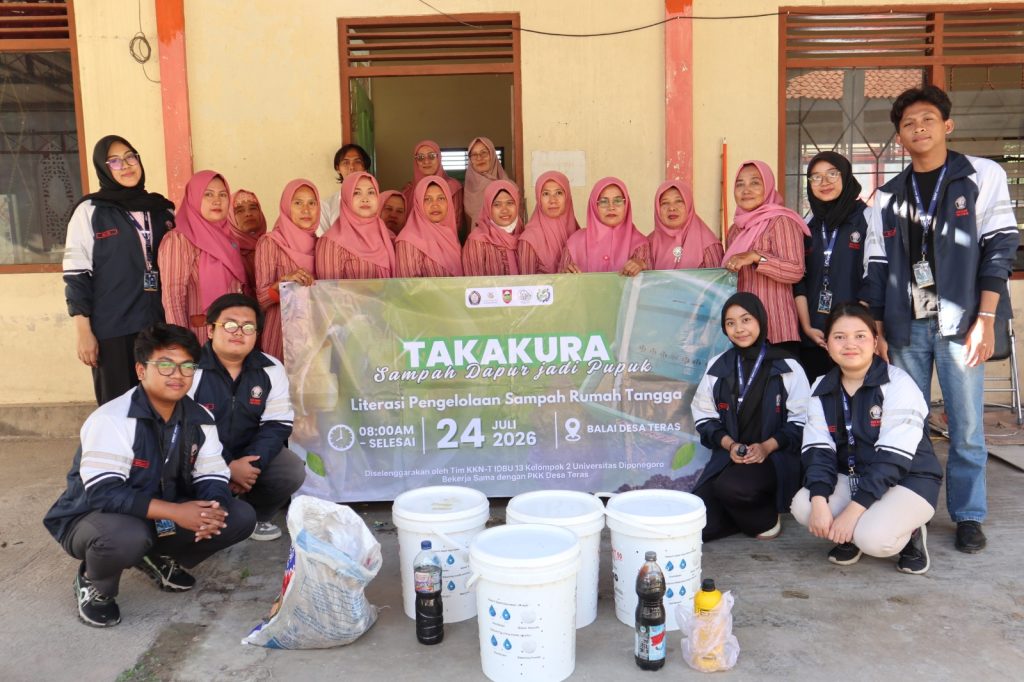
Boyolali, July 24, 2026 — Alifia Meisiana Nur Rahmawati, a student in the Information and Public Relations Program at Diponegoro University, took part in a household waste management literacy program organized by Group 2 students of the UNDIP IDBU 13 Community Service Program (KKNT) for the women of the PKK in Teras Village, Teras Subdistrict, Boyolali Regency, by handling the documentation and publicity of the event to ensure that information about the program reached a wide audience. The event was held at the Teras Village Hall and attended by 27 local PKK members.
The event consisted of two sessions: the first from 8:00–10:00 a.m. and the second from 1:00–3:00 p.m. The event opened with remarks from the Head of Teras Village, Santoso, who expressed his support for this waste management literacy program as a collective effort to address household waste issues in the village.
This program employs the 4I Literacy Model, a practical information literacy framework consisting of four stages: Recognize, Search, Evaluate, and Apply. Through this approach, the PKK women were guided to recognize the problems associated with household organic waste, search for management solutions, evaluate the most suitable methods for their community, and directly practice the waste management methods they had learned.
The material on the Takakura method was presented by Titan Yudha Prasetya, a KKN student from the Agribusiness Study Program. In his presentation, he explained that the Takakura method is a simple way to process household organic waste into compost using a special basket. This method is considered practical and easy to implement even in limited spaces such as a kitchen or a home patio, as it does not require the addition of other materials each time organic waste is added.
The tools and materials used in this method include a perforated basket with a lid, cardboard, rice husks, compost starter (EM4 and rice bran), and organic waste. Participants were also informed that the organic waste used must not contain proteins such as meat, sausage, milk, and eggs, as these materials can attract flies and insects and produce unpleasant odors.
As one of the program’s outcomes, the KKN team also developed a module on producing solid organic fertilizer using the Takakura method. The module was systematically organized and covers an introduction to the Takakura method, the necessary tools and materials, the steps for producing solid organic fertilizer, compost maintenance, and the utilization of the compost, thereby serving as a guide for PKK members to independently apply this method in their own homes.
The documentation and publication content created by Alifia was produced on an ongoing basis, starting two days (H-2) and one day (H-1) before the event as an initial preview, through to a recap on the day of the event (H), allowing the public to follow the series of events even before they took place. All content was published via the TikTok account @terasbercerita_, targeting college students and the general public, so that information about this waste management literacy program could gain wider recognition and reach a broader audience beyond the residents of Teras Village.
One participant, Tri, shared her impressions after taking part in the event. “Alhamdulillah, I’m grateful for the opportunity today to participate in the hands-on practice following the workshop. Maybe tomorrow we can practice on our own at home to make use of kitchen waste—especially so that nothing goes to waste, even if some items have gone bad, they can still be reprocessed,” she said. She also praised the way the KKN students presented the material. “It was really enjoyable; the older students explained the material very well. Hopefully, it can be even better in the future. Best of luck,” she added.
Through this program, the KKN-T IDBU 13 students from Diponegoro University hope that the PKK mothers in Teras Village will better understand the importance of independently managing household organic waste, while also contributing to reducing the volume of waste that ends up in landfills.